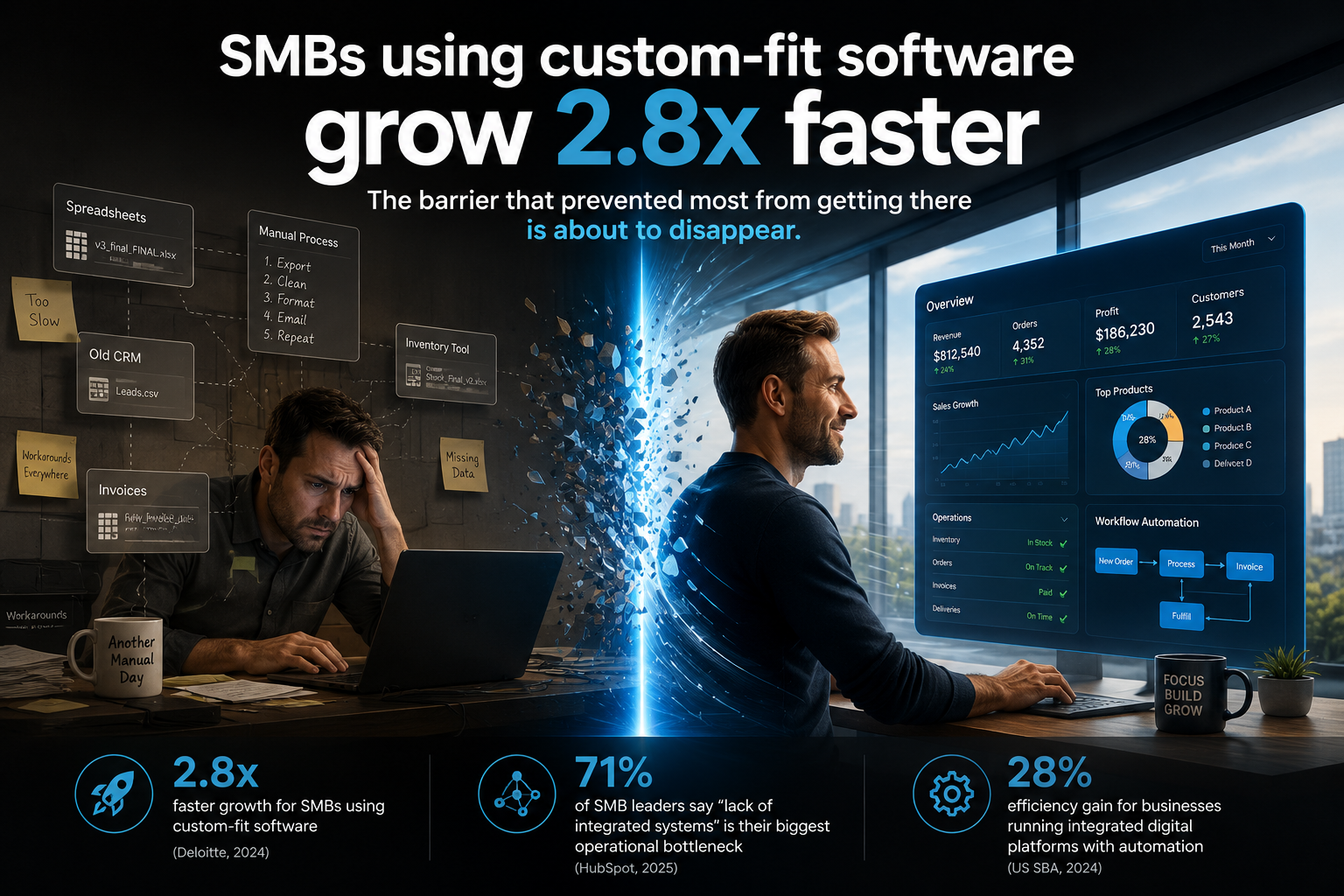
SMBs using custom-fit software grow 2.8x faster than those stuck with generic tools. The barrier that prevented most from getting there is about to disappear.
There is a quiet frustration running through every small and medium business on earth. You know your business better than any consultant ever will. You know exactly what your CRM should track, how your inventory system should behave, what your dashboard needs to show you at 8am on a Monday. And yet - for three decades - the only way to get software that truly fit your business was to spend serious money on someone who barely understood it.
The bill for that mismatch is enormous. Not just in consultant fees, but in growth potential that was never realised. In workflows that stayed manual because automating them was too expensive. In decisions that were made on instinct because the data was buried in three different tools that didn't talk to each other.
That era is ending.
The custom software gap has always been a growth gap
The evidence here is not subtle. SMBs that manage to build software genuinely tailored to their operations grow significantly faster than those stuck with off-the-shelf solutions. The performance gap between a business running bespoke tools and one running generic SaaS is wide enough to be the difference between a company that scales and one that plateaus.
Why does this happen? Because software that fits perfectly removes friction at every level. Faster decisions. Fewer workarounds. Less time spent managing tools instead of running the business. When your software thinks the way your business thinks, the compounding effect is real and measurable.
2.8x - faster growth for SMBs using custom-fit software vs. off-the-shelf peers (Deloitte, 2024)
71% - of SMB leaders say "lack of integrated systems" is their biggest operational bottleneck (HubSpot, 2025)
28% - efficiency gain for businesses running integrated digital platforms with automation (US SBA, 2024)
The 71% figure is worth sitting with. Nearly three in four SMB founders are being held back not by their market, their team, or their product - but by software that doesn't connect. This is not a minor operational annoyance. It is a structural cap on growth, baked in from day one.
The biggest leap in custom software isn't AI, low-code, or cloud. It's ownership. The smartest founders aren't just buying software - they're buying control of their operating system.
The Shopify parallel is exact
Before Shopify launched in 2006, building an e-commerce store required a web developer, a designer, a payment processor, and typically several months. The barrier wasn't will - there were thousands of founders who wanted to sell online. The barrier was access. Custom commerce was reserved for businesses that could afford it.
Shopify removed that barrier. The consequence wasn't just that existing businesses moved online cheaper. It was that an entirely new population of entrepreneurs entered the market - people who would never have started without the platform making it possible. The democratisation of commerce infrastructure created a wave of new businesses that simply did not exist before.
The same logic applies to business software. Today, building an app, a dashboard, a custom CRM, or an operational tool requires a developer. That means it requires a budget, a brief, a relationship, months of back-and-forth, and ongoing maintenance costs. Most SMBs do not have any of those things in the right combination. So they settle for generic.
When that barrier is removed - when a founder can describe their workflow in plain language and get back working software in minutes - the market doesn't just become more efficient. It expands. New businesses become viable. Existing ones unlock growth they couldn't access before.
This is not about cheaper consultants
It would be easy to frame this as a cost story. And the cost savings are real - the SMB software market is heading toward $150 billion by 2035, much of it driven by the shift away from expensive custom development toward accessible platforms. But the cost frame misses the deeper consequence.
The founder who couldn't previously afford custom software doesn't become a slightly more profitable version of themselves when that barrier drops. They become a different kind of business. One that can automate the operations holding them back. One that can build the exact tool their industry needs and doesn't yet have. One that can iterate their software as fast as their business model changes.
This is the kickstart effect. It's not just efficiency - it's the activation of entrepreneurial energy that was previously locked behind a technical and financial barrier that most founders could not cross.
Software is no longer discretionary for SMBs. The mindset has shifted. The question is no longer whether to build - it's whether you can build fast enough to keep pace with your own ambitions.
What happens when software fits perfectly
Imagine a logistics company with five employees running their own client portal, their own route optimisation tool, and their own invoicing dashboard - all built in a week, all connected, all reflecting exactly how they operate. No monthly fee to a tool built for 500-person companies. No workaround because the software doesn't support their edge case. No consultant on retainer for when something needs to change.
Or a boutique agency that builds its own project tracker with the exact reporting their clients want - and uses that same software as a sales asset, demonstrating operational professionalism that larger competitors can't match.
Or a restaurant group that builds its own reservation and staffing tool - tuned to their specific seasonal patterns, their specific team structure, their specific margins.
The competitive implications compound fast. Software that fits is a moat. It encodes the institutional knowledge of how a business actually works. It can't be replicated by a competitor who just buys the same SaaS subscription.
The macro picture
SMBs represent the backbone of every economy in Europe and beyond. They account for the majority of employment and a significant share of GDP. Yet they have historically operated with technology infrastructure built for enterprises, stripped down and repriced - not designed for them from the ground up.
The Shopify moment for business software doesn't just benefit individual companies. It changes the competitive structure of entire industries, creates new categories of tool that incumbents never thought to build, and raises the floor of what a small business can operationally achieve.
That is not a marginal improvement to the SMB market. That is a structural shift in what is possible.
The question for founders right now is not whether this shift is coming. It is already here. The question is whether you move before your competitors do - or whether you watch them unlock the operating system you could have had first.
Sources: Deloitte (2024), HubSpot (2025), US Small Business Administration (2024), Technavio (2025), Mordor Intelligence (2025), Market Research Future (2025)