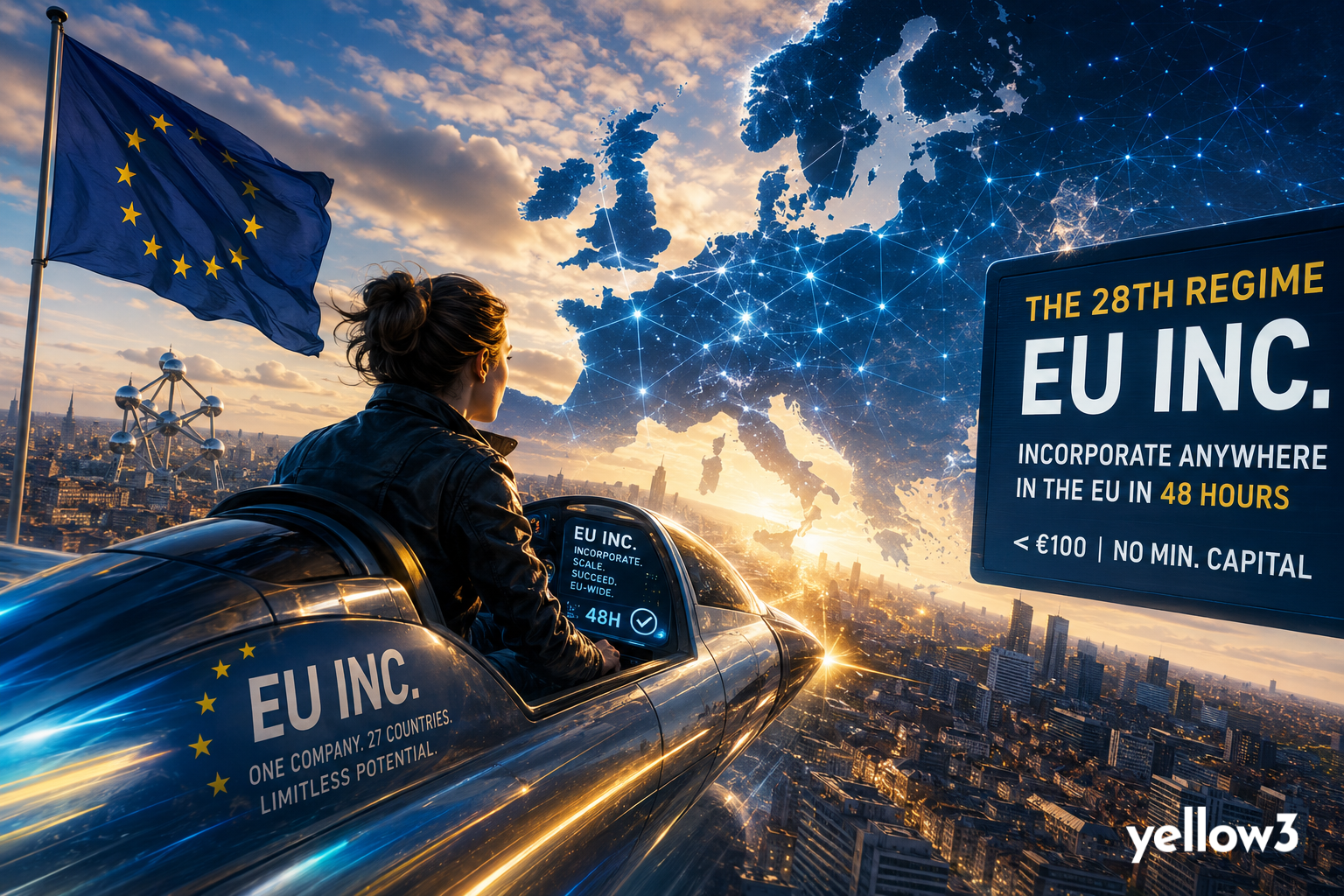
Today in Brussels, European Commission President Ursula von der Leyen launched EU Inc. - the so-called 28th regime that European founders, investors, and operators have been pushing for since before Draghi put it in writing. The proposal is real. The numbers are serious. Any entrepreneur will be able to incorporate a company across the entire EU Single Market within 48 hours, fully online, for less than €100, with no minimum share capital required.
I have been saying for years that Europe's problem is not talent, not ideas, not even capital in isolation. The problem is friction. Bureaucratic, legal, administrative friction that kills momentum - and momentum is everything when you are building a company.
What EU Inc. actually does
The Draghi report diagnosed the disease in 2024. It found that between 2008 and 2021, close to 30% of European unicorns relocated their headquarters abroad - the vast majority to the US. Not because they stopped being European. Because Europe made it too hard to stay and scale. EU Inc. is the Commission's surgical response to that specific problem.
This is not a symbolic gesture. The mechanics are meaningful: a single legal entity valid across all 27 member states, a "once only" principle meaning you register your company information once and it flows automatically to tax authorities across borders, and EU-wide employee stock option plans with deferred taxation. For the first time, a European founder can structure cap tables, hire talent, and raise capital without rebuilding the entire legal stack in every new market.
"Europe has the talent, the ideas and the ambition to become the best place for innovators. Yet today, European entrepreneurs who want to scale up face 27 legal systems and more than 60 national company forms."
Ursula von der Leyen said that this morning in Brussels. It is exactly right. And it has taken far too long to hear it from the Commission with a legislative proposal attached.
The gap no legislation can close
Here is what I want to be honest about, because I think the celebration needs a second layer of analysis. EU Inc. removes the legal friction. It does not remove the execution friction. And execution friction - the gap between having an idea and having a working product in front of a customer - remains enormous for the majority of European SMBs and solo founders.
Think about what it still takes to go from a business idea to a functioning digital product. You need developers, or an agency, or months of learning to code. You need infrastructure. You need a database. You need hosting, security, backend logic. You need someone to maintain all of it. For most European founders - especially outside the major tech hubs - that chain of dependencies is the real wall. Not the legal paperwork.
The EU is building the runway. That is genuinely important. But a runway without a plane is just a very expensive strip of tarmac.
What this means for European software builders
The timing is not accidental. EU Inc. arrives at precisely the moment when AI-native software platforms are making it possible to build and launch full-stack digital products from plain English. The two trends are converging. A founder in Warsaw, Lisbon, or Copenhagen can now - or very soon will be able to - incorporate an EU-wide company in 48 hours and launch an autonomous software product the same week. That combination did not exist two years ago.
Pleo's former leadership said it plainly when the proposal dropped this morning: EU Inc. could have enabled faster expansion, lower costs, and greater ambition - with the fragmentation of planning growth across borders removed. That framing is right. But the next generation of Pleo-scale companies will not just benefit from legal simplicity. They will be built by non-technical founders who use autonomous software tools to move at a speed that was previously only available to well-funded teams with large engineering departments.
The Draghi report was explicit that Europe's core deficit is in young, innovative, fast-scaling companies - particularly in digital and AI. EU Inc. addresses the legal side of that. The software autonomy movement addresses the capability side. One removes the bureaucratic ceiling. The other removes the technical floor.
The businesses it enables
The most consequential companies built on top of EU Inc. will not be founded by lawyers who understand the 28th regime. They will be founded by people with a clear problem to solve and tools that let them move without asking permission. Legal incorporation in 48 hours. A working product in hours. Distribution across 450 million consumers without rebuilding the company structure in every country. That is the scenario Europe has been trying to create for thirty years. It is now architecturally possible for the first time.
What I am watching next
The Commission is calling on the European Parliament and Council to reach agreement on EU Inc. by end of 2026. That is an ambitious timeline and political reality will test it. But the direction is set, the backing is broad - 22,000 signatories including Stripe's founders and funds from Sequoia to Index - and von der Leyen has staked credibility on delivery.
The more important question is what the ecosystem builds on top of this infrastructure. Legal frameworks are enabling conditions, not outcomes. The outcome is what a Danish SMB owner, a French solo founder, or a Bulgarian engineer does on the morning EU Inc. goes live. If the only thing that changes is the paperwork, Europe has won a bureaucratic battle while losing the innovation war.
The real test is whether European founders, armed with simpler legal infrastructure and increasingly powerful autonomous software tools, start building at a pace that finally closes the gap with the US. That is the thesis. March 18, 2026 is a meaningful data point in that story. Not the conclusion of it.