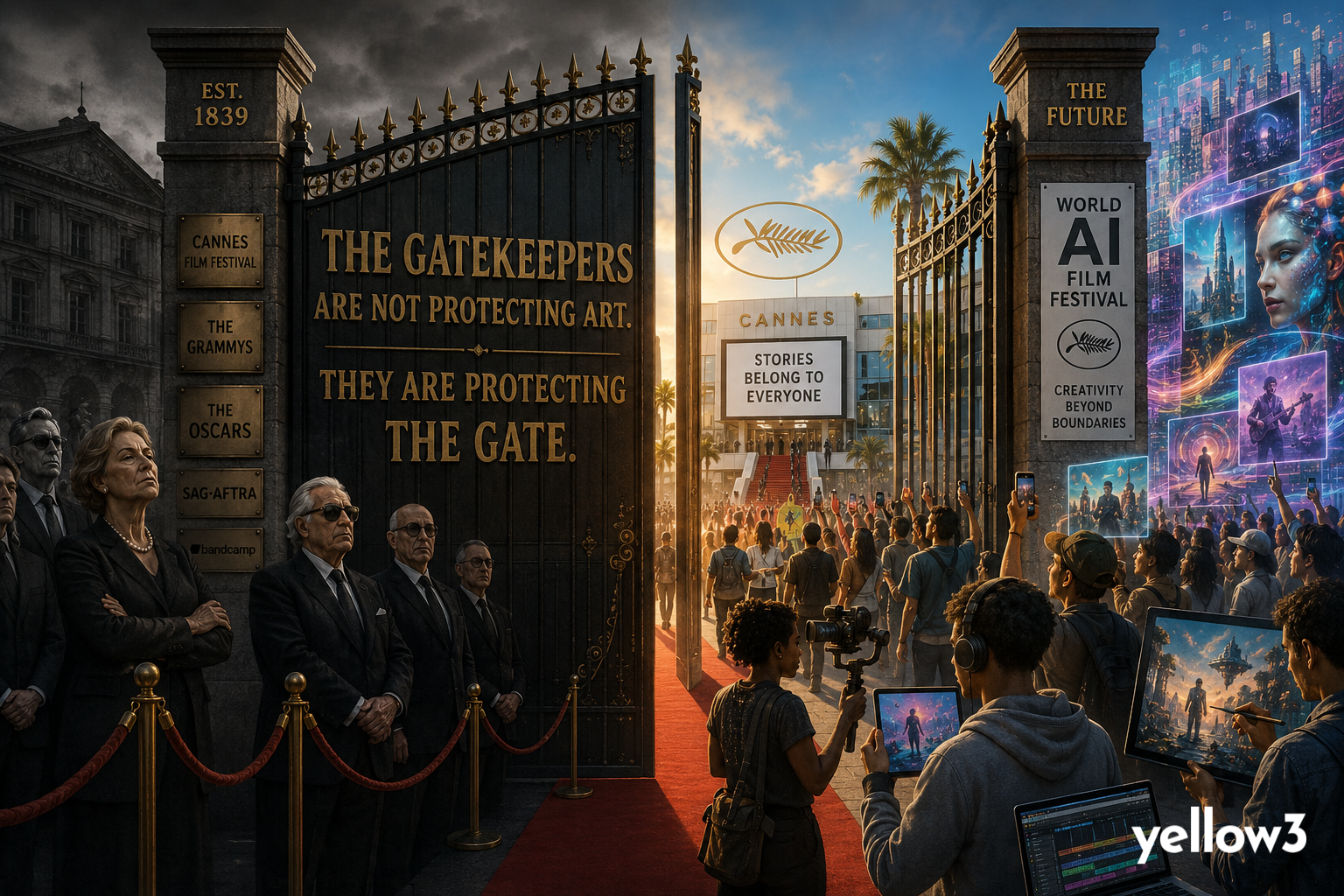
Every film at Cannes this year is an assembly of data. Digital cameras record data. Colour grading manipulates data. Sound design layers data. The VFX pipeline that Cannes explicitly permits is data being shaped by humans into pictures. Thierry Fremaux, the festival's General Delegate, said the quiet part out loud in the same week: Coppola's Apocalypse Now was, in his words, "the last organic film." Everything since has been digital. Everything since has been an assembly of data.
So the line Cannes drew is not really between data and not-data. It is between data the gatekeepers consider artistic and data they do not. That is a different question, and it deserves a different conversation.
The same week, three institutions drew the same line
Cannes was not alone. The Recording Academy updated its Grammy rules to say that a work containing no human authorship is ineligible in any category, and that any human contribution must be "meaningful and more than de minimis." The Academy of Motion Picture Arts and Sciences confirmed for the 99th Oscars that screenplays must be human-authored, and that only roles "demonstrably performed by humans with their consent" qualify for acting awards. Bandcamp banned music "generated wholly or in substantial part by AI." SAG-AFTRA declared that the AI character Tilly Norwood is "not an actor."
Read together, this looks like consensus. Read more carefully, it looks like coordination. Three of the most powerful gatekeeping institutions in Western culture, plus the unions that depend on them, arrived at almost identical language inside a single award cycle.
The reasoning offered is always about creativity. The structure underneath is about who gets to decide what counts.
A familiar pattern
In 1839, when Louis Daguerre's photographic process was first reported to the Paris Academy of Sciences, a Dutch periodical warned that "an invention" had arrived "which could cause some alarm to our Dutch painters." Sunlight, the writer said, had been elevated "to the rank of drawing master." Faithful depictions of nature could now be made in "a few minutes."
The reaction was immediate. Photography would be the death of painting. It would replace the portraitist. It would devalue craft. It would let anyone produce an image without years of training. Charles Baudelaire called it the refuge of "every would-be painter, every painter too ill-endowed or too lazy to complete his studies."
By 1855, an anonymous writer was already pushing back: the prediction that photography "would be the death of art" had, he wrote, "proven mistaken." Experience showed instead that photography marked "the breaking of a new dawn for art." Painting did not die. It reinvented itself, repeatedly, for the next hundred and fifty years. Impressionism, Post-Impressionism, Cubism, abstraction, conceptual art - none of these were responses to a healthy painting tradition. They were responses to a medium whose old job had been taken.
The Paris Salon, the official gatekeeper of nineteenth-century French art, did not welcome photography. It did not welcome the Impressionists either. So in 1874 the Impressionists held their own exhibition. The Salon survived. The Impressionists survived. History remembers one of them better than the other.
This is the pattern. A new tool arrives. It lowers the cost of producing something the existing professionals charge for. The professionals' institutions tighten their rules. The new tool's practitioners build new institutions. The work continues. The audience decides.
What the rules are actually doing
Cannes built a separate festival, the World AI Film Festival, that runs at the same Palais des Festivals three weeks before the main event. Submissions to WAIFF jumped from 1,000 last year to 5,000 this year. Ron Howard, James Cameron and Matthew McConaughey are publicly backing it. Joanna Popper, an LA film and tech executive who judged the festival, told reporters that Hollywood studios are interested in making "several $50 million AI or hybrid films instead of one $200 million conventional film."
This is the part of the story that the press release does not capture. Cannes did not ban AI from its venue. It moved AI to a different bracket. The main competition stays "human" and keeps its prestige value intact. The AI bracket grows commercially in the same building. Both are now Cannes products. Both protect the brand.
The Grammy rule is structurally similar. AI-assisted work is eligible, as long as a human contribution is "meaningful." Who decides what is meaningful? The Academy. Auto-Tune was once accused of being the death of vocal craft. It is now on almost every record that wins. Sampling was once theft. It is now a genre. The rules will move. They always do. The question is who controls the moving.
"It has no life experience"
The most common objection to AI work is that the machine has not lived. SAG-AFTRA's statement on Tilly Norwood put it bluntly: the character "has no life experience to draw from, no emotion."
This is the strongest emotional argument the institutions have. It is also philosophically thin.
No tool has lived. A camera has not lived. A guitar has not lived. A film stock has not lived. The life experience in any work belongs to the human who chose what to do with the tool. When a director uses a generative model to compose a shot they could not otherwise afford, the choice is theirs. The taste is theirs. The years of watching films and reading scripts and feeling things in dark rooms are theirs. The model is the brush.
What is true is that some AI work is bad. So is some painting, some music, some film. The existence of bad work in a medium is not an argument against the medium. It is an argument for criticism.
What is also true is that some AI work is built on training data taken without consent or compensation. That is a serious problem. It is a copyright and licensing problem, and it deserves a serious legal answer. It is not, however, the same problem as whether AI-made work should be allowed to compete for awards. Conflating the two lets the institutions use the legitimate grievance to defend the illegitimate exclusion.
The democratisation argument, honestly stated
The case for AI as a creative tool is not that everyone is now an artist. The case is that the cost of entering the conversation has fallen by an order of magnitude, and the people who could not previously afford to enter now can.
A teenager in Lagos can compose a short film. A first-time songwriter in Sao Paulo can hear their melody arranged for orchestra. A founder in Copenhagen can prototype an application without writing code. None of these people are taking work from the existing professionals at the top of the industry. They are entering a conversation they were previously priced out of.
Most of what they make will not be good. That has always been true of any expanding medium. Most novels are bad. Most films are bad. Most songs are bad. The relevant question is whether the small fraction that is good gets a hearing. The Cannes rule says no, not in the main competition. The Grammy rule says no, not unless we judge the human part of you significant enough. The Oscars rule says no, not in acting, not now.
These are not neutral aesthetic standards. They are policy choices about who is allowed in the room.
What the audience does
There is one piece of evidence that the institutions cannot rule on. Audiences have already started choosing. A song substantially generated by AI was one of the most popular on Spotify in Sweden last year before reporters identified its origin and the country's charts removed it. People liked it before they knew. They presumably stopped liking it when told to. Perhaps they will start liking it again when the labelling stops mattering. Perhaps not.
Either way, the answer to whether AI-made culture is "real" culture is not going to come from a rulebook in Beverly Hills or a press conference in Cannes. It is going to come from billions of small decisions about what to listen to, what to watch, what to share, what to keep.
That is how it has always worked. The Salon did not get to decide whether Monet mattered. The audience did. The audience took about thirty years to decide, but it decided.
What this means for the next ten years
Three things are likely.
First, the parallel institutions will grow. WAIFF this year. Something equivalent for music within twenty-four months. Something equivalent for literature shortly after. The new institutions will eventually have their own prestige, their own canon, their own bad-faith gatekeepers. That is the cycle.
Second, the existing institutions will quietly move their lines. The Grammy rule already allows "more than de minimis" human contribution. The Oscar rule disclosed but does not ban. In five years the language will read differently. In ten it will read very differently. By then the current statements will sound like the 1839 warning about sunlight and drawing masters.
Third, the audience will get bigger. More people will make things. More people will share things. More people will be heard. Some of those people will turn out to be the next generation of artists the institutions will eventually try to claim they discovered.
The institutions are not protecting art. Art does not need protecting from its own expansion. They are protecting the gate.
The gate has always been the temporary part.